If you're going to teach English in Spain, Barcelona is the obvious place to start. It has the biggest expat teaching community in the country, a constant demand for teachers, and a quality of life that turns a one-year plan into a much longer story. You're never far from the beach, the mountains or a terrace in the sun.
This guide covers the whole picture: the jobs, the money, what it costs to live here, where to live, getting set up, visas and how to qualify. Want the quick personalised version? Take the free 60-second check.
The teaching job market
Barcelona is home to over 100 language academies, and they're only the start. The real opportunity is in spreading your work across several sources:
Language academies — your bread and butter starting out, teaching kids, teens and adults in the late afternoons and evenings.
In-company business English — classes for professionals, often in the mornings, and some of the best-paid work going.
Private one-to-one students — easy to find once you're set up, and the rate is yours to keep.
Exam prep, summer camps and online — Cambridge and Trinity prep is in constant demand, and online classes top up your timetable.
Hiring runs all year, but there are two big waves: September (by far the largest) and January. Arrive a few weeks before either and you'll walk into the busiest hiring period.
A lot of teaching here is freelance, so many teachers register as autónomo (self-employed) and combine an academy contract with their own private and business classes. It sounds daunting, but it's completely normal and we show our trainees exactly how to do it.
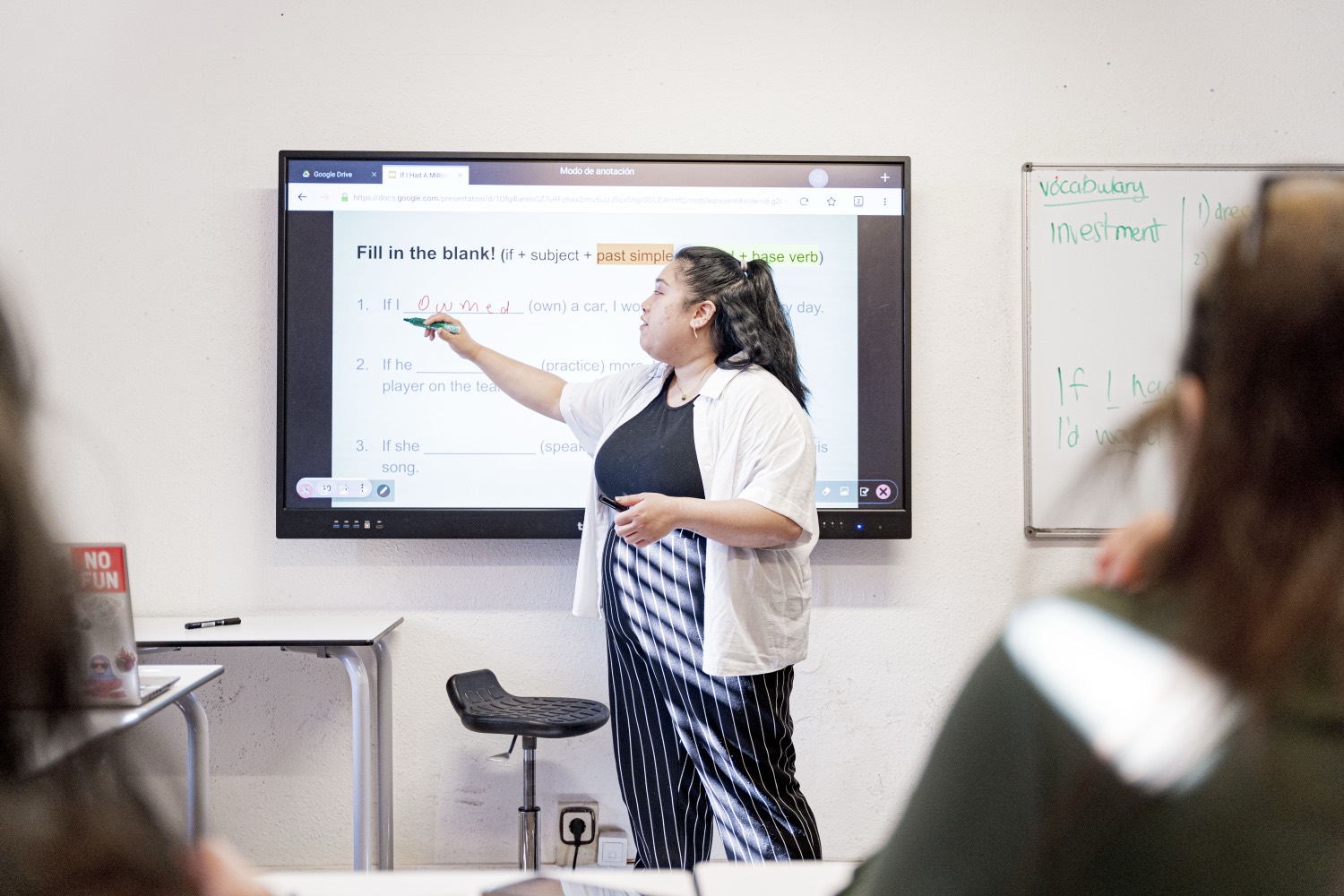
Academy classes are where most new teachers start.
What you'll earn
Let's be straight: you won't get rich, but you'll live well. New teachers typically earn around €1,500 a month, built from a mix of work. Rough going rates in Barcelona look like this:
Language academy (per hour)
€12–18
Private one-to-one (per hour)
€15–25
In-company / business (per hour)
€20–35
Online teaching (per hour)
€10–20
Typical monthly take, new teacher~€1,500
The trick is to start with academy hours for stability, then layer private and business classes on top as your reputation grows. Within a year, many teachers comfortably clear that figure. (Rates are approximate 2026 guides and vary by experience and employer.)
Cost of living
This is where Barcelona wins. It's dramatically cheaper than London or New York while handing you a city most people only get to visit. Here's a realistic monthly budget for a new teacher:
Room in a shared city-centre flat
€569
Transport (T-usual monthly pass)
~€20
Groceries
~€200
Eating out & going out
~€150
Phone
~€15
Health insurance
~€55
Comfortable monthly total~€1,000
So a new teacher's salary covers a genuinely good life here, with room left for the weekends away that made you want to move in the first place. (Figures are indicative 2026 estimates; rents in particular vary by neighbourhood and timing.)
Your salary stretches a long way in Barcelona.
Where to live
Every barrio has its own personality. These are the ones teachers tend to land in:
Gràcia
Most popular
Villagey, bohemian, packed with squares and bars. A long-time favourite with teachers.
Rooms from ~€500–650
Poblenou
Beach side
Modern, creative and a short cycle from the sand. Quieter, more space for your money.
Rooms from ~€500–650
Sants
Best value
Local, friendly and brilliantly connected. The most affordable central-ish option.
Rooms from ~€450–550
Poble-sec / Sant Antoni
Foodie favourite
Trendy, central and stuffed with great tapas. A sweet spot of price and buzz.
Rooms from ~€500–600
Eixample
Central
The elegant grid: wide avenues, modernist buildings, walkable to everything.
Rooms from ~€550–700
El Born & Gothic
Historic heart
Medieval streets, nightlife on the doorstep. Lively and central, at a premium.
Rooms from ~€550–700
How to actually find a flat
Start with Idealista, Badi and Spotahome, plus the Barcelona flatshare Facebook groups.
Most people rent a habitación (room) at first, it's cheaper and the fastest way to meet people.
Expect to pay roughly a month's deposit plus the first month up front.
Never pay before viewing in person. If a "landlord" is abroad and wants a deposit to post the keys, it's a scam.
Your first two weeks
A quick run of admin gets you fully set up. Don't panic, thousands of people do this every year:
1
Sort your NIE / TIE
Your foreigner ID number, needed for almost everything. Non-EU teachers get this as part of the visa process.
2
Empadronamiento (the padrón)
Register at your local town hall once you have an address. Quick, free, and needed for other paperwork.
3
Open a bank account
A Spanish account makes getting paid and paying rent far easier. Several banks offer easy non-resident options.
4
Get a Spanish SIM
Cheap pay-as-you-go or contract SIMs are everywhere; you'll want a local number for job-hunting.
5
Grab a transport card
The T-usual gives you unlimited metro, bus and tram. The network is excellent.
6
Sort health cover
EU citizens use the GHIC/EHIC; non-EU teachers take out private health insurance (often required for the visa).
Visa & legal
It comes down to your passport. EU or EEA citizens can live and work in Barcelona with no visa at all. Everyone else needs one, and the cleanest route is the student visa via a long course, which lets you live here and teach part-time.
The visa rules tightened in 2025 (your school must be Instituto Cervantes accredited, and you apply from your home country). The full picture is in our complete guide, or just run the free check and we'll map your exact route.
Life in Barcelona
This is the part that sells itself. Beach in the morning, mountains at the weekend, 300-plus days of sun, and a food scene that runs from €1 vermut to Michelin stars. The international community is huge, so you'll find your feet within days.
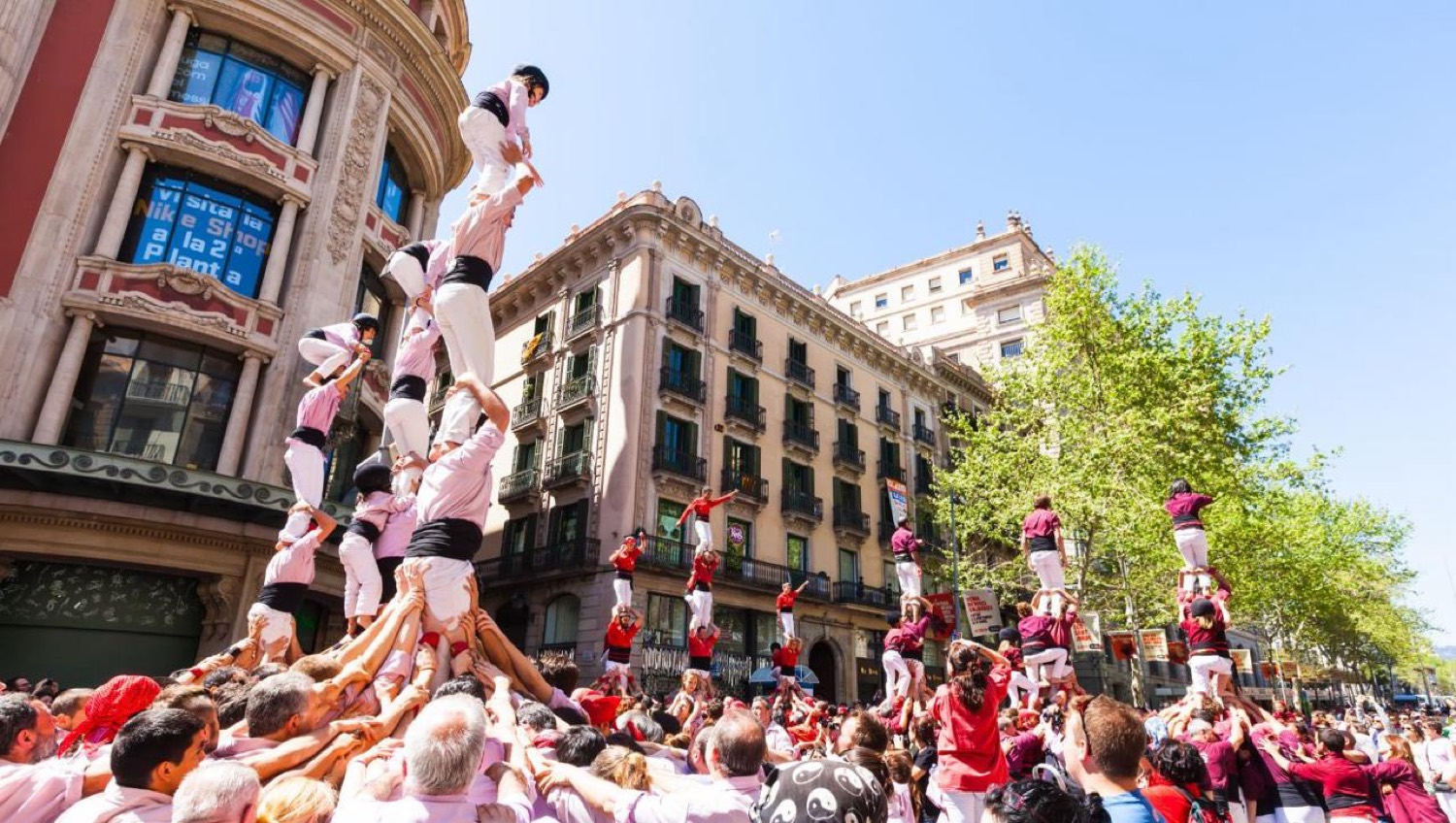
Festivals: La Mercè, Sant Joan, Sant Jordi, and the gravity-defying castellers (human towers).
Day trips: Montserrat, Sitges, Girona and the Costa Brava are all an easy train ride away.
The language: you'll pick up Spanish (and a little Catalan) just by living it, and our sister school ILA can help.
Castellers: one of Catalonia's most spectacular traditions.
Get qualified in Barcelona
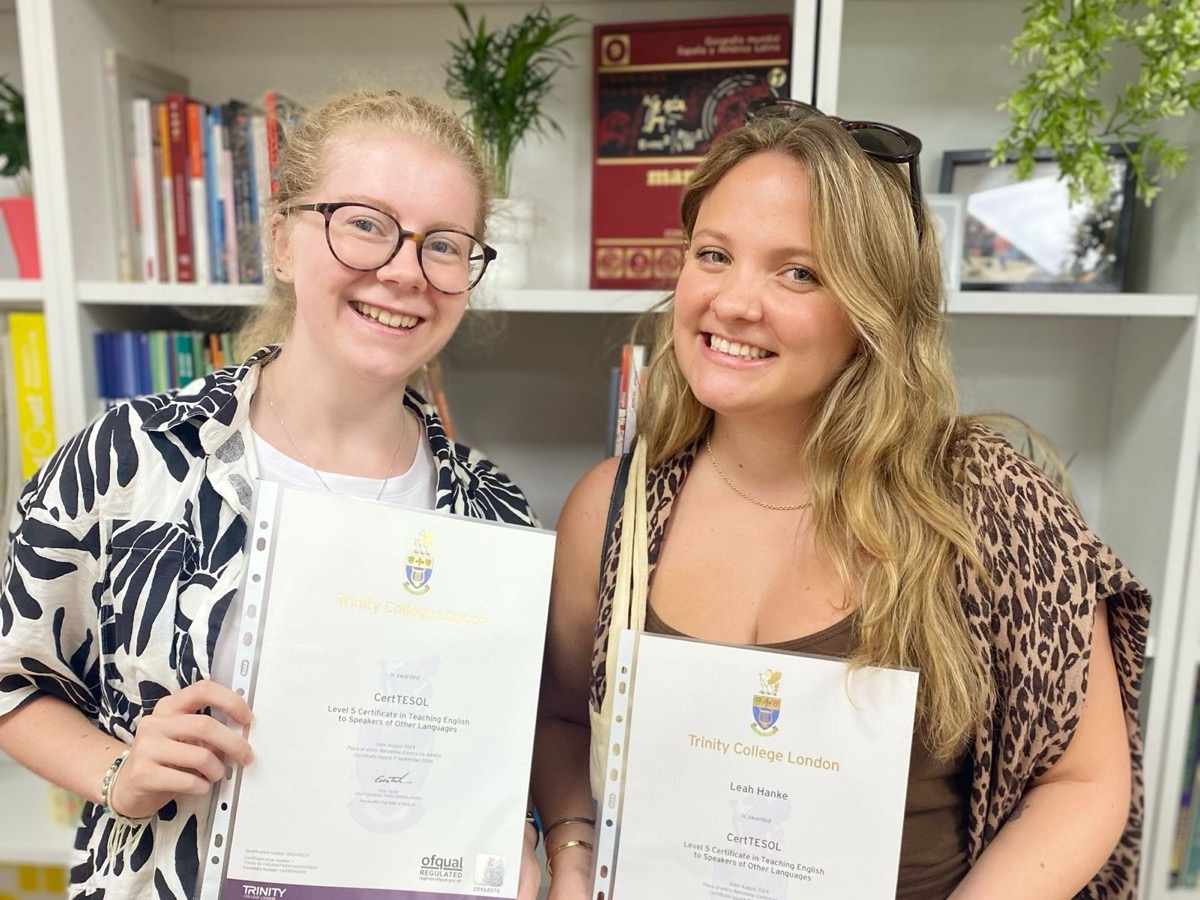
The smartest move is to get qualified in the city, so you finish your course already here, already job-hunting, with local contacts and a school that knows you. Our Trinity CertTESOL runs over four weeks, full-time, with six-plus hours of teaching real students and hands-on help finding work afterwards. You don't need to be a native speaker, and you don't strictly need a degree.
Qualified and ready to work, in a month.
Barcelona vs Madrid
The two big choices. Madrid has more teaching jobs, slightly lower rents and a more immersive, very-Spanish feel. Barcelona has the beach, the mountains, the bigger international scene and (let's be honest) the better weekends, in exchange for a little more competition for hours. Both are excellent. If lifestyle is high on your list, Barcelona is hard to beat.
Frequently asked questions
Do I need a degree to teach English in Barcelona?
No, not strictly. A degree helps and opens a couple of extra doors, but solid life or work experience counts too. What every employer wants is a recognised teaching certificate.
Do I need to be a native English speaker?
No. You need to speak and write English to a high standard. Around 1 in 5 of the teachers we train aren't native speakers.
Do I need to speak Spanish?
Not to get started, English classes are taught in English. But picking up Spanish makes daily life easier and you'll absorb it quickly just by being here.
When's the best time to arrive?
Aim for late August / early September for the biggest hiring wave, or late December / January for the second. Arriving a few weeks before lets you get set up first.
Can non-EU citizens teach in Barcelona?
Yes. You'll need a visa, and the most popular route is the student visa via a long course. Take the free check to see your exact route.
How much can I really earn?
New teachers typically earn around €1,500 a month, built from academy, private and business classes. It rises with experience and the right mix of work.
Start here
Barcelona has a way of turning a one-year plan into a much longer story. Take the free eligibility check, get qualified, and we'll help you land the job. The life you keep scrolling past is genuinely closer than you think.
We use cookies to see how the site is used and make it better. You can accept analytics cookies, or carry on with just the essential ones. See our Cookie Policy.